ARIEL TIME
Ariel – “Time Machine” | Generalist Artist at Mathematic Studio

For this commercial project produced at Mathematic Studio in Paris, I worked as a Generalist 3D Artist on one of the key sequences of the film: the “Gladiator Side” environment, inspired by the Roman arena seen in Gladiator II. The client, Ariel (P&G), needed a visually striking and instantly recognizable Roman world for their “Time Machine” advertising campaign
"A cinematic journey through different historical eras to highlight the power of Ariel Grandiose to restore color and brightness to clothes."


Background fully made in Maya / Houdini, with procédural workflow.
crowd on Houdini Solaris, made by Loris Eck, an FX artist.
Working closely with the production team and the client’s creative vision, I contributed to the reconstruction of the Roman arena, shaping an environment that balanced historical authenticity, cinematic scale, and stylized advertising aesthetics.
This included environment building, layout, texturing, asset integration, and collaboration with lighting and FX teams to ensure the arena fit seamlessly within the narrative and the time-travel transitions.

Note: The project is still in production, so I don’t have the final renders to show yet. They will be available on my website as soon as the commercial is officially released.
Camera Tests & VFX Integration

Once the 3D modeling and layout of the Roman arena were completed, I worked extensively on camera tests and render previews to prepare the final shots. Since the plates and VFX elements from the live-action set arrived after the initial 3D environment was finished, a large part of the process involved iterating on camera placement to ensure perfect integration between the actors, the set pieces, and the digital arena.
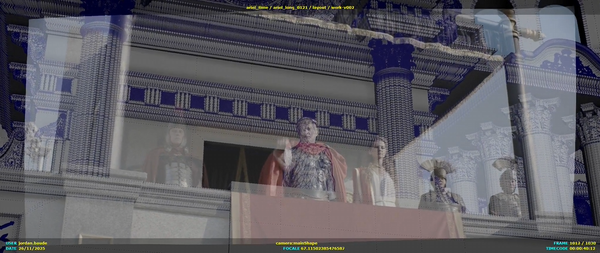

This phase required close collaboration with compositing and VFX supervisors as we aligned the CG environment to match the on-set material. I refined camera angles, adjusted lens parameters, and produced multiple render passes to achieve a seamless blend between the filmed footage and the 3D world. These itérations were crucial to maintaining the cinematic intent of the scene while respecting the director’s vision and the client’s expectations.
Modeling & Texturing
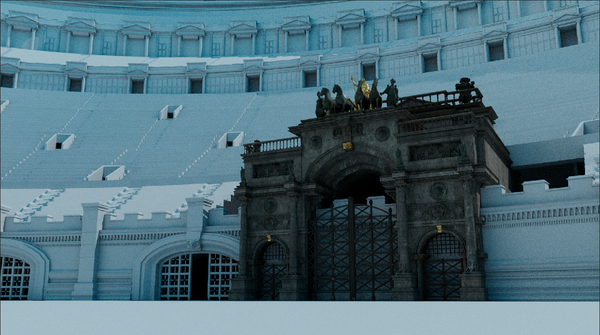
For the “Gladiator Side” sequence, I handled the modeling and texturing of the Roman arena environment, taking direct inspiration from the visual language of Gladiator II while adapting it to the stylized needs of the commercial. The goal was to create a structure that felt historically grounded, massive, and immediately readable from camera.


I built the architectural elements, arena walls podium structures, stone blocks, ornamental details while maintaining a modular and efficient workflow. The texturing phase focused on achieving credible material definition: aged stone, sand-covered surfaces, and weathered details that enhanced the realism once integrated into the shot. Everything had to support the cinematic direction while staying light enough for production constraints.


Lighting & Set Integration
When the photogrammetry and on-set reference material arrived, I worked on lighting the CG arena to match the real set. This included using shadow matte and shadow catcher setups to anchor the actors and practical elements inside the 3D environment.


By combining the on-set photogrammetry with the CG layout, I ensured that shadows, light direction, and ground interaction felt natural and physically consistent. The lighting pass was also crucial for blending the digital arena with the plate, reinforcing scale and atmosphere without overpowering the live-action performance.
This step involved continuous back-and-forth with compositing to make sure the CG behaved exactly like the practical set, ultimately helping the arena feel like a seamless extension of what was shot.

